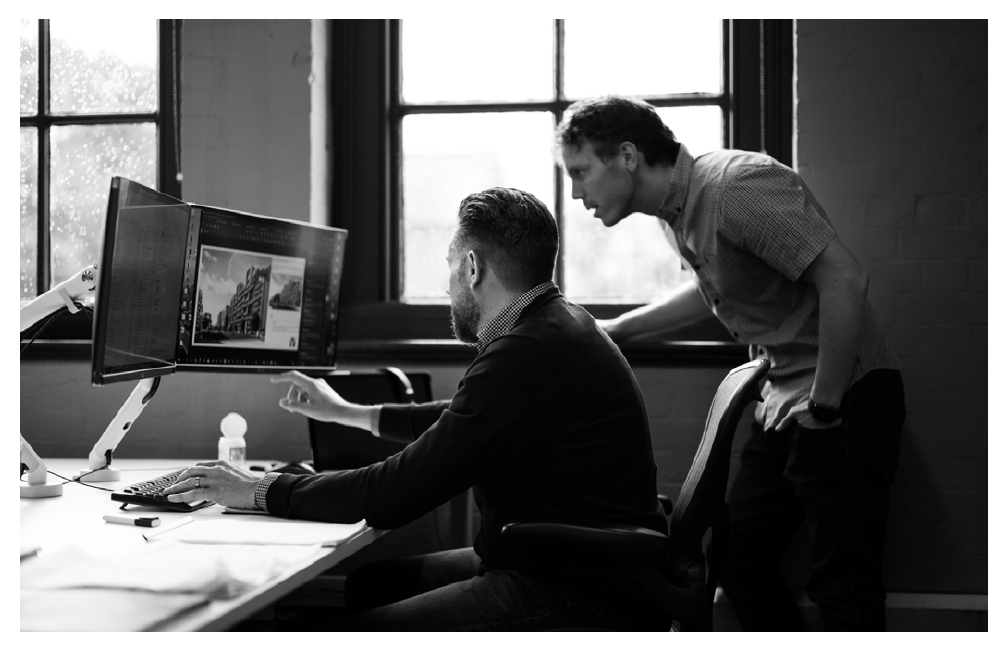
Our Creative Director, John Crighton provides a run down of V1’s approach to advances in tech.
The ever-changing digital world has always been a hotspot for advancements and tech disruptors, and recent years have been no exception. Most of the attention has centered around AI, metaverse and Web 3, but V1 takes a different path. Our focus is on improving operations in more tangible ways; maximizing efficiency while ensuring the highest quality of product. In the flurry of render engines that have come and gone over the past two decades, Chaos group’s Vray remains steadfast as a tool that gives our artists unprecedented freedom to consistently create incredible imagery and animation. Its robustness and capacity make it unparalleled in its contribution to visual excellence; its influence cannot be overstated.
At times, it can be tempting when trying to improve ourselves to jump full-on into a new set of processes or capabilities. But more often than not it is those who focus and patiently build upon what has served them in the past that really produce the most successful results. Learning and honing our craft over time requires patience, but the trade off of a deep understanding and mastery of something that has never let us down where we might fail with a newer approach is invaluable. Our ability to stick by John Crighton Creative Director with something that works for us and organically grow within it can lead to greater achievements over time than if we just blindly go searching for the next shiny object.
The toolset in Vray continues to improve with each release. Such advancements like procedural clouds, Multiple additive dome lights and light mix amongst others keep renders looking fresh and improve realism and efficiency. Clients demands for moving and animated CGI content continues to increase, Vray’s performance in this department has been consistently impressive over the years, and they continue to outshine their competitors. Not only have they developed innovative products and features, but they also offer unparalleled customer service and support. Their dedication to excellence is unmatched and can be seen in their tutorials, technical documents, and ongoing training programs.
Focus on Gaming by Jacob Goodship

There has been a longstanding stigma around gaming and what it positively contributes to society. However, it has recently become apparent that games are one of the main driving forces behind development in technology, especially the digital arts. Be that Archviz, Real-time experiences, NFT’s, or even Films.
Companies are now seeing the demand and have the resources to develop technology to push the boundaries of what is capable in a game. One of the greatest developments has been real-time raytracing. Due to the release of the next generation of consoles, this has become a readily available feature in a lot of games within most households. It is no longer reserved for the high-end PC. Raytracing allows for the accurate representation of lighting solutions within a digital render. This can be represented in the form of reflection, refraction and shadows. Traditionally, raytracing was limited to precalculated renders, which would mean that changes to an image would have a large impact on the timescale of a project. However, due to its inclusion within games ray tracing has now started to become real-time meaning that alterations to an image can be previewed as the artist makes them.
Another huge development we are noticing in the ArchViz industry that can be attributed to the gaming sector is the quality and availability of photogrammetry models and PBR materials. Photogrammetry models refers to a 3D model that has been created by taking a series of photos and scans of a real-world asset. This data is then run through model generating software, which is subsequently refined by an artist. Many of these models would be very time consuming for an individual artist to create, so having them already available allows for an artist to spend more time being creative and producing a higher quality final image.
PBR materials is an abbreviation for Physical Based Rendering. This refers to a material within 3D rendering software that is composed of multiple maps that have been captured in the real-world. These maps are then combined in a specific way within the 3D rendering software to give a result that is as close to the real-world physical material as possible. This is another great example of a time saving development that enables artists to focus more on the creativity of an Archviz image.